
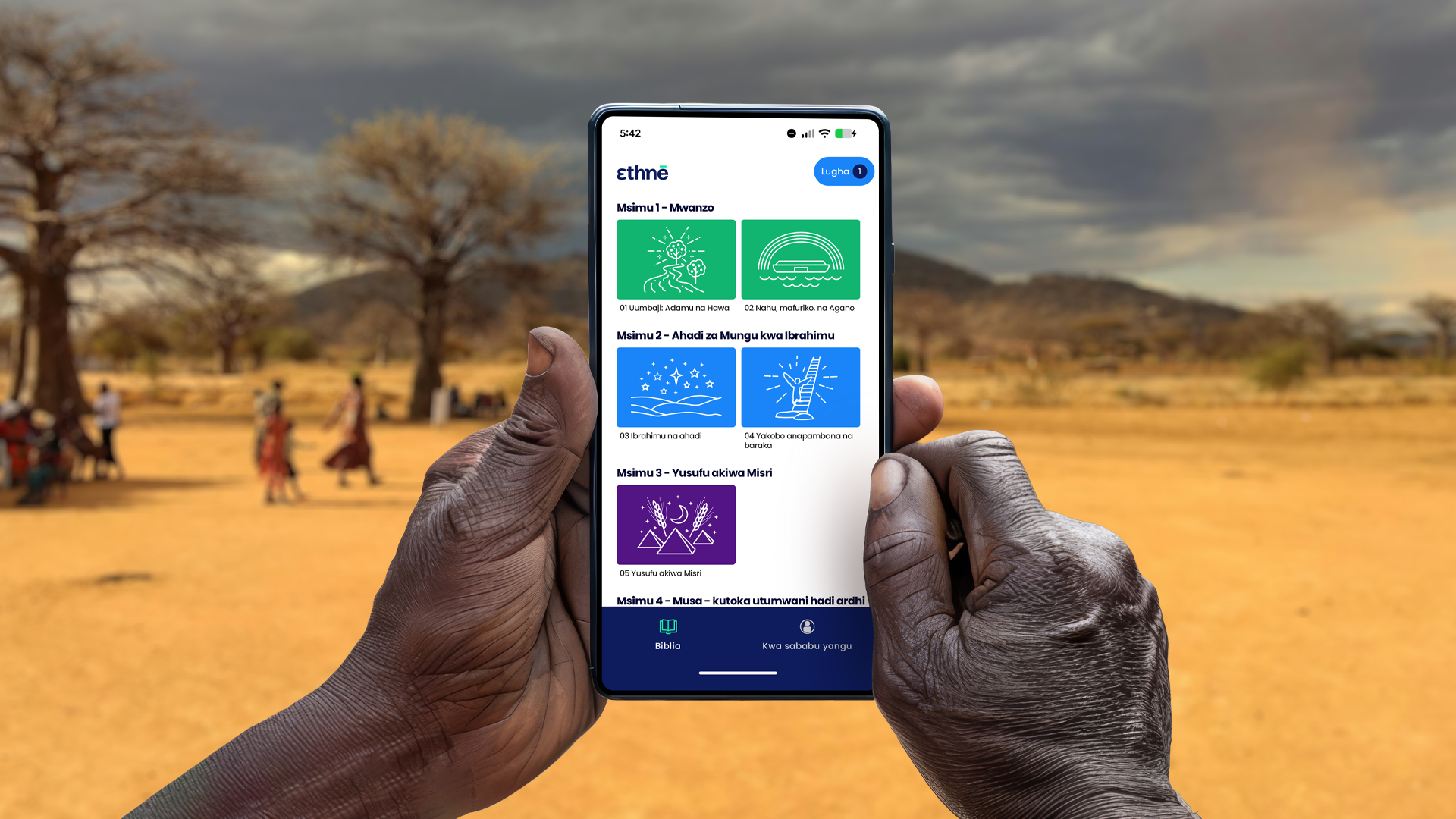
Swahili Audio and Text Bible translation added to ethnē!
Swahili Full Bible Audio and Text translation from Biblica, Inc added to ethnē!

Estimated Speakers: 150–200 Million
Geographic Distribution: Spoken across East and Central Africa, including Tanzania, Kenya, Uganda, Rwanda, Burundi, and the DRC
Learn more: Ethnologue, Joshua Project and Wikipedia
Swahili, known natively as Kiswahili, ranks among the most widely spoken languages in the world. Estimates of the total number of first- and second-language Swahili speakers generally range from 150 million to 200 million. Native speakers, known as the Waswahili, number around 5 to 10 million and live primarily along the East African coast. As a second language, Swahili reaches across Tanzania, Kenya, Uganda, Rwanda, Burundi, the Democratic Republic of Congo, and parts of Mozambique, Malawi, and Zambia. Linguistically, Swahili belongs to the Sabaki group of the Northeast Coast Bantu languages and falls within group G of Guthrie's referential classification, sharing this family with languages such as Pokomo, Mijikenda, and Comorian.
Swahili holds remarkable institutional standing across the continent. It serves as one of the official languages of the African Union, and UNESCO has recognized it as one of the ten most widely spoken languages in the world, designating July 7 as World Kiswahili Language Day. It functions as the language of administration and primary education in Tanzania, an official language alongside English in Kenya, a recognized national language in Uganda, and one of the four languages of administration in the Democratic Republic of Congo. For the Christian communities spread across this vast, multilingual region, a Swahili Bible translation is indispensable. Swahili is the heart language for millions of coastal believers and the shared second language for many more across dozens of ethnic backgrounds, and without Scripture in Swahili, countless communities would rely on English or French to access the Bible, introducing unnecessary barriers to personal faith and communal worship.
Show this QR code to a friend so that they can experience this Swahili Bible in ethnē today!

The Swahili language carries extraordinary linguistic breadth and historical depth that makes a translation into it uniquely valuable. Linguists identify approximately 15 main dialects, with the three most prominent being kiUnguja (spoken on Zanzibar and forming the basis of standard Swahili), kiMvita (spoken in Mombasa and coastal Kenya), and kiAmu (spoken on the island of Lamu). Swahili was originally written in the Ajami script, an Arabic-based writing system, before transitioning to the Latin alphabet in the 19th century; it retains a vocabulary in which around 40% of words derive from Arabic, with additional loanwords from Portuguese, English, and German. Unlike most other Bantu languages, Swahili is not tonal, which contributes to its accessibility as a learned lingua franca, while its elaborate noun class system, in which agreement markers on verbs and adjectives reflect the category of each noun, remains a distinctively Bantu structural feature that speakers navigate fluently in daily communication.
Across East and Central Africa, Swahili-language Scripture functions as a unifying resource for churches that regularly draw together believers from many different ethnic and linguistic communities. Pastors, evangelists, and teachers use Swahili to lead Bible studies, preach sermons, and disciple believers who share no other common tongue. The Swahili Bible has become a major tool in Christian ministry and functions as the most widely read book in East and Central Africa. An audio Bible in Swahili extends this reach even further by serving oral learners and communities with limited access to written materials, allowing them to engage with the full sweep of Scripture in a language that resonates deeply. As churches across Tanzania, Kenya, Uganda, Congo, and beyond continue to grow, a Swahili audio Bible equips indigenous leaders to root their congregations in the story of Scripture, strengthening both personal faith and the broader body of Christ throughout the region.
Have a question, or an idea to share? Reach out anytime — we usually reply within a day.
Download ethnē — the Bible app for all peoples.



