
Munda New Testament Audio Bible added to ethnē!
Munda New Testament Bible Audio translation from Davar Partners International added to ethnē!

Estimated Speakers: Approximately 1.5 million
Geographic Distribution: Spoken primarily in Jharkhand, with communities in Odisha, West Bengal, and Bangladesh
Learn more: Ethnologue, Joshua Project and Wikipedia
Having a Munda Bible translation is critically important for reaching one of India's oldest indigenous tribal communities. Mundari is a Munda language of the Austroasiatic language family spoken by the Munda tribes native to the Chota Nagpur Plateau region in India, with over 1.5 million native speakers. It is closely related to Ho and Santali, and along with Bhumij, is one of the four major Munda languages. The Munda primarily inhabit the eastern states of Jharkhand, West Bengal, and Odisha, specifically in the Khunti, Ranchi, Simdega, Paschim Singhbhum, Gumla, Purbi Singhbhum, and Ramghar districts of Jharkhand; the Sundargarh and Sambalpur districts of Odisha; and the Jalpaiguri, Paschim Medinipur, and North 24 Parganas districts of West Bengal, with additional communities in Bangladesh and Nepal. In 2011, Jharkhand recognized Mundari as an additional official language of the state under the Jharkhand Official Language (Amendment) Act, allowing the language to be used in administrative and cultural contexts alongside Hindi.
For churches, missionary organizations, and faith communities throughout this region, providing the Bible in Mundari ensures that the Christian message reaches speakers in their heart language, the language in which they think, pray, and express their deepest beliefs. Many Mundari speakers are bilingual in Hindi or the local state language, yet these acquired languages cannot carry the spiritual weight that the mother tongue holds for personal devotion and community worship. Without a quality Mundari Bible translation, over a million speakers must rely on Scripture in languages that create barriers to deep spiritual understanding and personal connection with the biblical text. UNESCO has classified Mundari as a vulnerable language, making the availability of Scripture in Mundari all the more urgent for both linguistic preservation and spiritual vitality.
Show this QR code to a friend so that they can experience this Munda Bible in ethnē today!
It is important to note that this Munda Bible translation holds unique value for a community with a rich oral heritage and a distinct linguistic identity. Mundari has two main dialects: Hasada, spoken east of the Ranchi-Chaibasa Road, and Naguri, spoken to the west. Mundari speakers write their language using the indigenous Mundari Bani script, also known as Mundari Bani Hisir, which Rohidas Singh Nag created in 1949 and refined over subsequent decades; it was added to Unicode in 2021. Mundari is also written with the Devanagari, Odia, Bengali, and Latin scripts. Munda peoples often reside in less accessible regions and are recognized as Scheduled Tribes in India, reflecting their historically marginalized status. This translation affirms the distinct identity and value of Mundari speakers, and it allows theological discussions, worship, and biblical education to take place entirely in Mundari, enabling preachers, teachers, and believers to communicate biblical concepts using culturally grounded idioms, metaphors, and linguistic structures that resonate with Munda communities.
Many Munda are Christians, with Christian missionary activity in the Chotanagpur region beginning in 1845, initiating a gradual influx of converts primarily from Oraon and Munda tribes that continues to shape the region's church landscape today. Churches use Munda Scripture translations in worship services, Sunday schools, and personal devotional practices, making Scripture memorization, study, and prayer more natural and meaningful for Mundari-speaking believers. The audio format carries particular significance for this community, as it allows believers who face literacy barriers to engage fully with God's Word in their heart language. A quality Munda translation also supports the growth of indigenous Mundari-speaking Christian leadership, as pastors and theologians study and teach Scripture without depending on the linguistic mediation of Hindi or other regional languages.
Have a question, or an idea to share? Reach out anytime — we usually reply within a day.
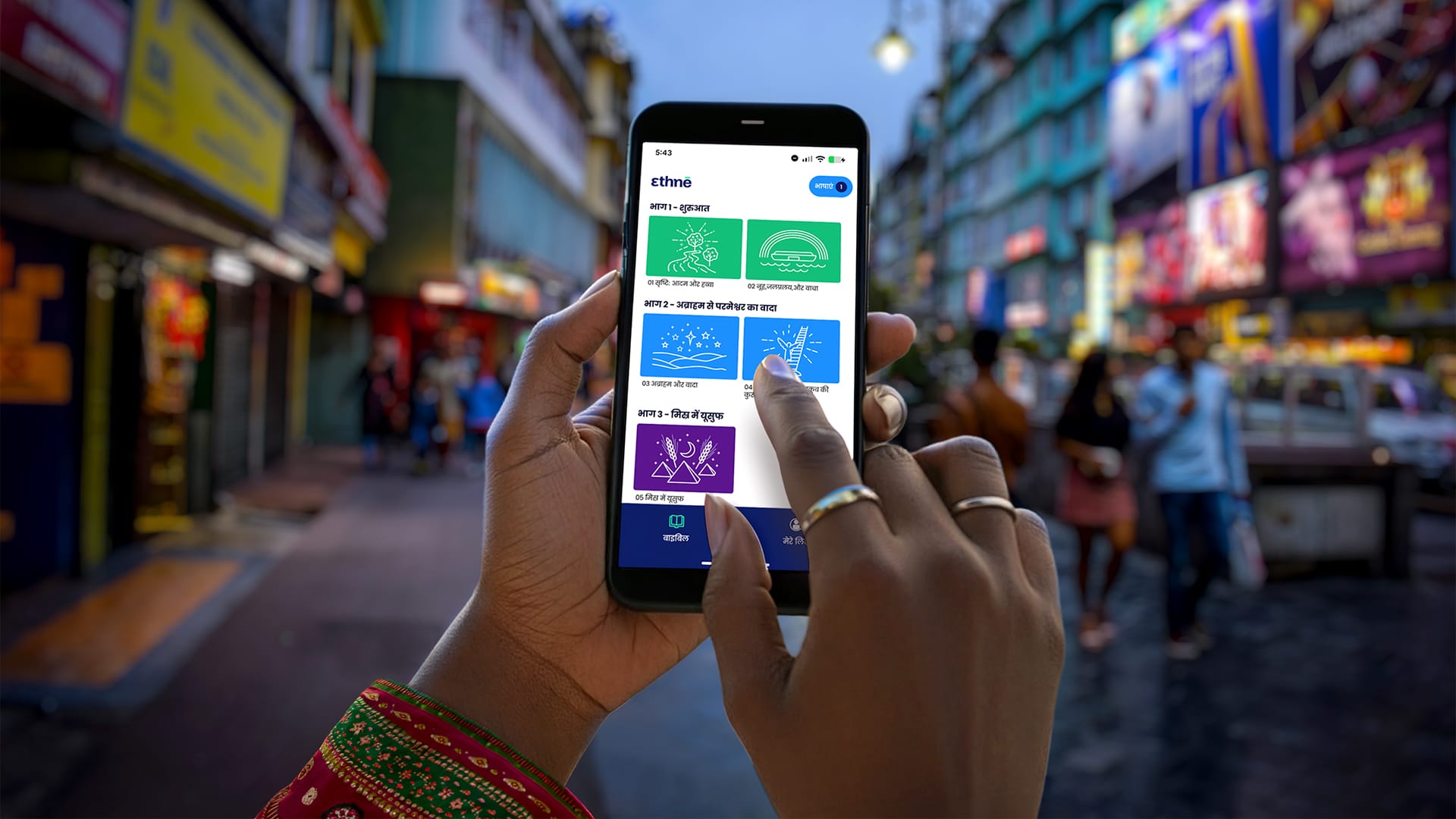
Download ethnē — the Bible app for all peoples.



