
Indian Revised Version (IRV) - Odia Full Bible translation added to ethnē!
Odia Full Bible Audio and Text translation from Davar Partners International and Bridge Connectivity Solutions added to ethnē!

Estimated Speakers: 45–50 Million
Geographic Distribution: Spoken primarily in Odisha, with communities in West Bengal, Jharkhand, Chhattisgarh, and Andhra Pradesh
Learn more: Ethnologue, Joshua Project and Wikipedia
Having an Odia Bible translation is critically important for reaching millions of believers across eastern India. Odia is an Eastern Indo-Aryan language and the official language of Odisha, where native speakers make up approximately 82% of the population. The 2011 Census of India counted approximately 37.5 million native Odia speakers concentrated in Odisha, with additional communities in neighboring states such as West Bengal, Jharkhand, Chhattisgarh, and Andhra Pradesh. Migration and trade have carried the language further, bringing the total number of Odia speakers worldwide to around 50 million, with diaspora communities present in countries including Thailand, Indonesia, the United States, Canada, Australia, and England. India recognized Odia as its sixth classical language, a status reflecting the language's unbroken literary tradition, with inscriptions dating back over a thousand years to its Magadhi Prakrit roots.
For the Christian communities scattered across Odisha and neighboring states, having the Bible in Odia ensures that Scripture reaches speakers in their heart language—the language in which people think, pray, and express their deepest convictions. The relationship between Odia and Christian mission runs deep: the first Odia-language Bible portions were translated by William Carey in 1808, with a fuller standard version produced by Amos Sutton in the 1840s, making Odia one of the earliest Indian languages to receive Scripture. Without an accessible Odia Bible translation, millions of speakers would depend on Hindi or English renderings that can distance them from Scripture's personal power and meaning.
Show this QR code to a friend so that they can experience this Odia Bible in ethnē today!

The Odia language features several dialects, with Mughalbandi (also called Coastal Odia) serving as the standard form used in education, government, and media. Other significant dialects include Sambalpuri in the western districts, Baleswari in the northern Balasore region, Ganjami in the south near the Andhra Pradesh border, Desiya among tribal communities in Koraput and Malkangiri, and Koshali in the Kalahandi and Bolangir districts. The Odia script is a Brahmic abugida developed over more than a thousand years, with its distinctively rounded letterforms arising from the ancient practice of writing on palm leaves, where straight lines risk tearing the surface. Scholars note that Odia stands out among Indian languages for its remarkable resistance to the influence of Persian and Arabic, preserving a closer connection to its Sanskrit and Prakrit origins than most neighboring tongues. The Odia IRV translation draws on this rich linguistic heritage, presenting Scripture in a form that resonates with the natural rhythms of the language across its many regional communities.
According to the 2011 Census, Christians make up approximately 2.77% of Odisha's population, numbering around 1.16 million people, with the majority coming from adivasi and tribal communities. Odia-speaking churches across these districts rely on Scripture in the local language to conduct worship, train emerging leaders, and carry out discipleship among oral-learning communities. A Bible in Odia removes barriers for many tribal and rural believers, allowing pastors and congregants alike to engage directly with God's Word in the language of their hearts and homes.
Have a question, or an idea to share? Reach out anytime — we usually reply within a day.
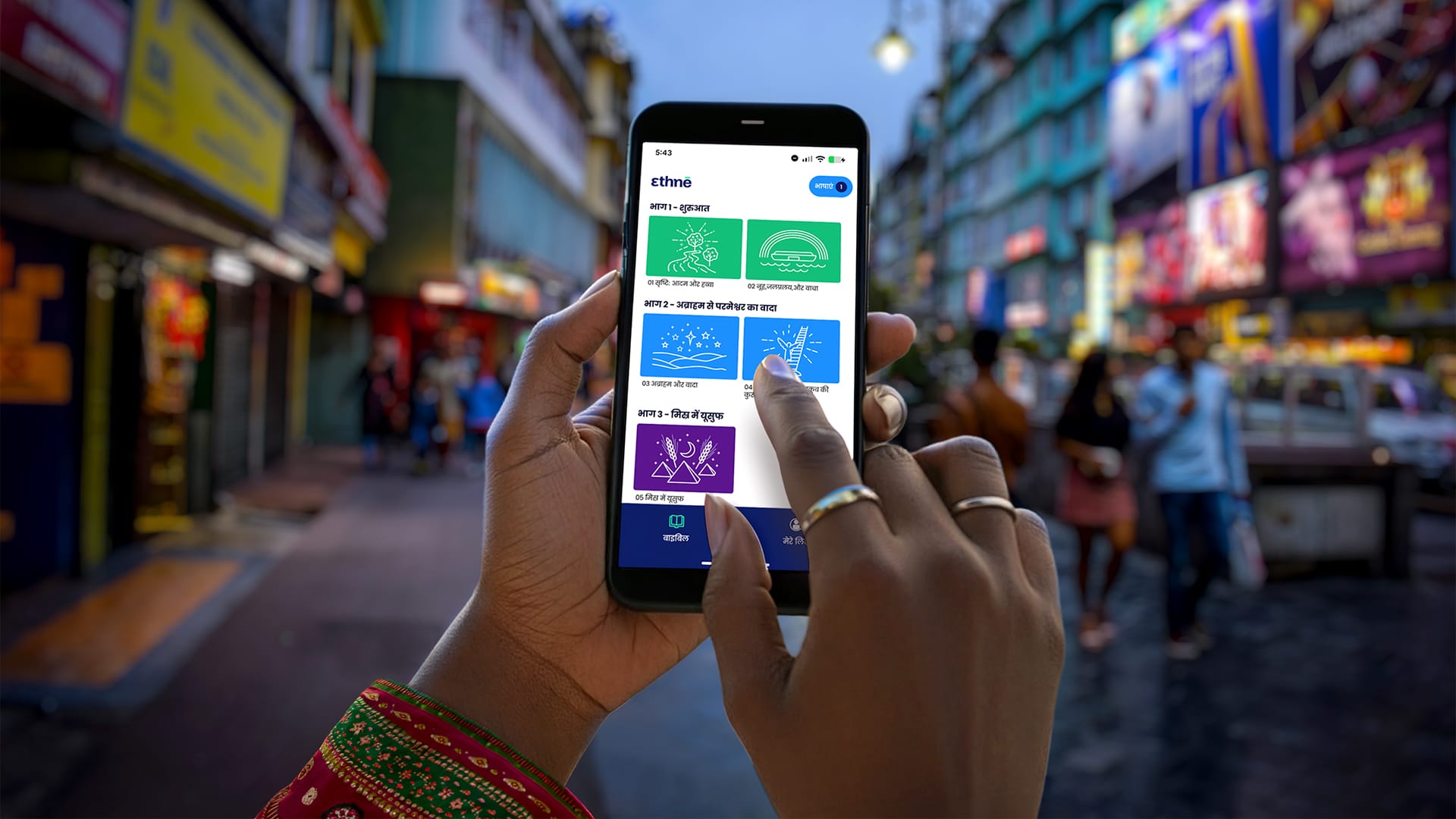
Download ethnē — the Bible app for all peoples.



