
Indian Revised Version (IRV) - Malayalam Bible translation added to ethnē!
Malayalam Full Bible Audio and Text translation from Davar Partners International and Bridge Connectivity Solutions added to ethnē!

Estimated Speakers: 35–38 Million
Geographic Distribution: Spoken primarily across Kerala, Lakshadweep, and Puducherry (Mahé), with large diaspora communities throughout the Middle East, North America, and Europe
Learn more: Ethnologue, Joshua Project and Wikipedia
Having a Malayalam Bible translation is critically important for reaching millions of believers across South India and the global Malayali diaspora. Malayalam is a Dravidian language spoken by approximately 35 to 38 million people, primarily in the Indian state of Kerala and the union territories of Lakshadweep and Puducherry (Mahé district). The Government of India officially designated Malayalam as a Classical Language in 2013, recognizing its literary tradition stretching back to at least the 9th century CE. Malayalam holds official language status in Kerala, Lakshadweep, and Puducherry (Mahé), and its speakers belong to one of the most literate and culturally distinct communities in South Asia.
For churches, missionary organizations, and faith communities serving this broadly distributed population, providing Scripture in Malayalam ensures that the Christian message reaches believers in their heart language. A heart language is the language in which a person thinks, prays, and expresses their deepest convictions. Significant Malayali populations reside in the Persian Gulf, across Malaysia, Australia, Canada, and the United States, meaning this translation carries global reach. Without a quality Malayalam translation, millions of speakers would be left engaging with Scripture through other languages that create distance rather than intimacy in their relationship with the biblical text.
Show this QR code to a friend so that they can experience this Malayalam Bible in ethnē today!

This Malayalam Bible translation holds unique value for a language community whose dialectal richness and literary heritage run exceptionally deep. Ethnologue identifies over fifteen dialects of Malayalam, including regional varieties such as North Kerala, Central Kerala, and South Kerala, alongside communal dialects tied to specific religious communities such as the Nasrani, Namboodiri, and Mappila varieties. The modern Malayalam script traces its origins to the Grantha script, a descendant of Brahmi, and contains 53 characters covering a broad phonological range that includes the retroflex consonants characteristic of South Dravidian languages. Unlike other Dravidian languages, Malayalam inflects its finite verb for tense only and not for person, number, or gender, making it grammatically distinctive within its language family. The classical Manipravalam literary tradition, which wove together Malayalam and Sanskrit, shaped the language's higher registers and continues to give the written form a vocabulary that resonates with centuries of cultural and religious heritage, providing a meaningful base for Scripture translation that honors the full depth of the language.
Churches use Malayalam Scripture translations in worship services, Sunday schools, and personal devotional practices, making Scripture memorization, study, and prayer more natural and meaningful. Christianity constitutes approximately 18 percent of Kerala's population, and the Saint Thomas Christians trace their origins to the evangelistic activity of Thomas the Apostle in the 1st century, making the Malayali church one of the oldest continuous Christian communities in the world. Today, Kerala's believers worship across a wide spectrum of denominations, including Syro-Malabar Catholics, Malankara Orthodox Syrian Christians, Mar Thoma Syrian Christians, Latin Catholics, and a growing number of Pentecostal and evangelical congregations. A quality Malayalam IRV translation equips pastors and theologians to study and teach Scripture without linguistic mediation, while the audio format serves diaspora believers and rural communities where hearing God's Word in one's heart language deepens personal devotion and strengthens the growth of indigenous Malayali-speaking Christian leadership.
Have a question, or an idea to share? Reach out anytime — we usually reply within a day.
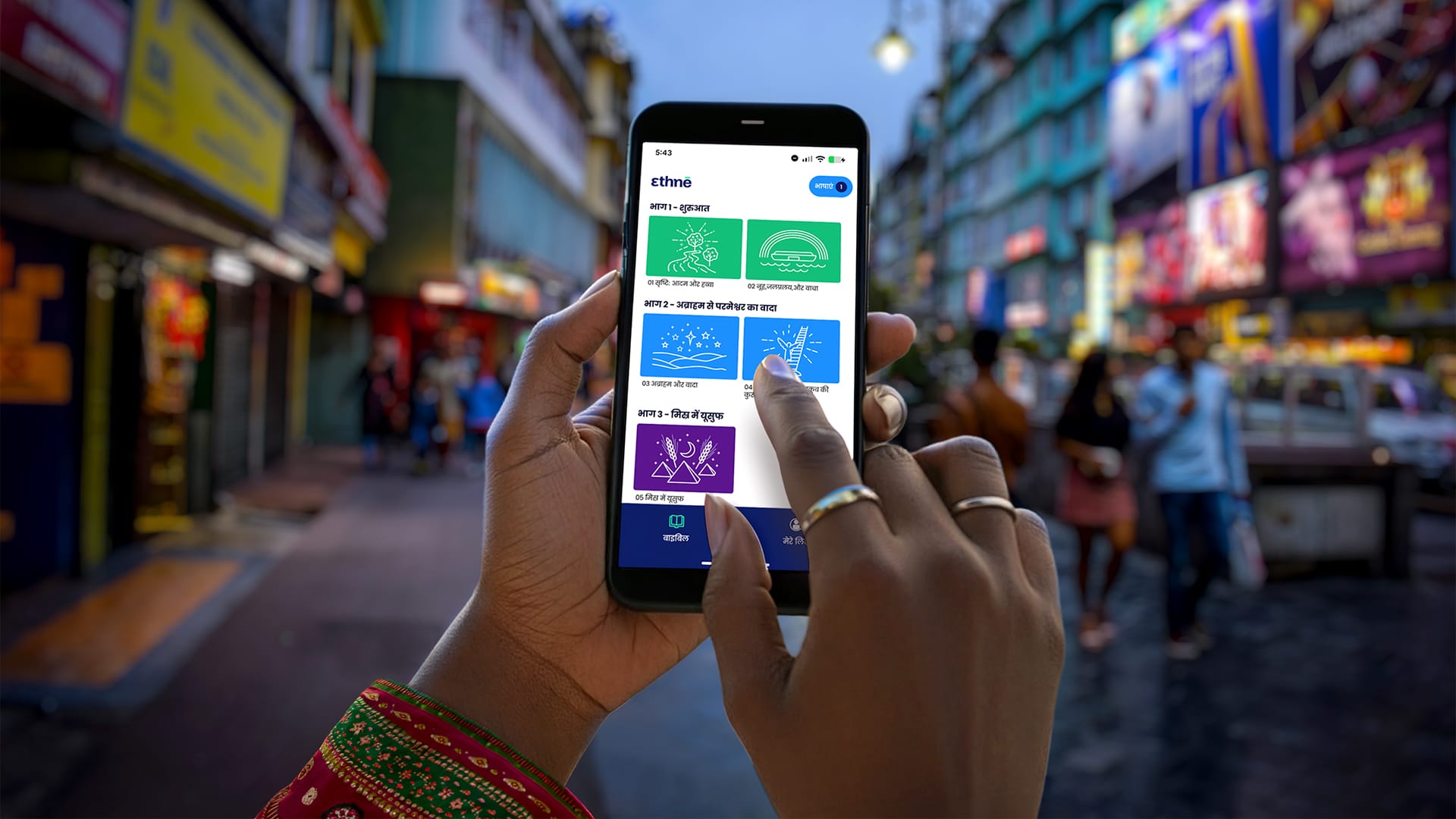
Download ethnē — the Bible app for all peoples.



