
What Bible translators from the West began hundreds of years ago, the church in the Last Mile, with those who come alongside them, will complete in this generation.
Our technology and our service model bring the parts of the Body together — so the whole can finish what no part can finish alone.
This is the future we imagine and an invitation to co-create it.
Part One
What we have done and are doing
Over 100 translation tools
The translation process is familiar. And the tools are good — built for parts of the process, for specific ministries, for specific methods. The trouble was never the pieces.
Good pieces, made in different shops — never designed to fit together.
The answer is not to force the pieces to fit, or to make new tools. The answer is to connect existing software to the community and the Word of God. The ethnē app is that connection — built to work with any software and any method.
We began with the end in mind
First, we started at the end. Scripture engagement technology, made for how the Last Mile uses their languages and phones.

ethnē is an app to help people experience the Bible in their heart language for the first time and share it offline with others.
Then we built the bridge to it
The Publishing Portal: Oral Bible translators publish each portion into the ethnē app the day they decide it’s ready by dragging and dropping, from any translation tool.
Iterative publishing
Bible translators publish early and often
“Getting finished Scripture into hands and hearts always came later, after my part was done. That always bothered me. Now a Portal runs from my translation software straight into the ethnē app, an app made for how my people use language and technology. Now a finished passage goes into my people’s hands the day it’s ready.”
— an Oral Bible translator
How it worksWith the ethnē Publishing Portal, Bible translators publish early and often to the ethnē app.
The voices on this page are illustrative — drawn from real conversations and the future we are building toward. Where you read “how it works,” it is working today; where you read “how it will work,” you are reading our intent.
The proof
Early OBT adoption, growing momentum
Our current focus is partnering with indigenous OBT translators so they can publish consultant-approved portions of Scripture for early use in their communities.
In May 2026, at the ETEN OBT Global Gathering, we launched the ability for translation teams to publish their own work directly in the app.
First 90 days since the OBT Global Gathering
10
translators, from different organizations
43
translations published early in their projects
5,000+
passages listened to
650+
shared person to person
New OBT translations are added every week — translators try it, keep using it, and bring other translators with them.
Status
Now publishing — audio Bible portions by oral Bible translators.
Instant stats. Early impact.
As the community encounters and shares the Word, the translation team sees it — in real time, safe and anonymous. This motivates the team and informs stakeholders.
Iterative publishing with instant stats
Translation teams see engagement in real time
“I manage twelve Oral Bible translation projects, and I could not see whether anyone was using the work we had completed. It made reporting something I dreaded. Now with ethnē, I open a link and watch, in real time, Scripture being listened to and shared. It motivates me, and reporting has never been easier, or meant more.”
— an OBT project coordinator
How it worksThe translation team receives a link to real-time stats of listens and shares. It is theirs, to share with whomever they want.
The voices on this page are illustrative — drawn from real conversations and the future we are building toward. Where you read “how it works,” it is working today; where you read “how it will work,” you are reading our intent.
Publish from any software into the ethnē app
Any software
Iterative publishing
Completed translations
ethnē
The Word of God, freely shared, one person to the next

Across every step
Connect any software to publish to the ethnē app
Connect once, and your software of choice publishes iteratively into the ethnē app, proven and made for offline use in multimodal and multilingual contexts.
StatusReady to connect
PricingA one-time connection, at a one-time cost
Across every step
Sign languages in the ethnē app, publishing early
Deaf teams get a first-class experience in the ethnē app, publishing sign language video early and iteratively. And the people in their household and community who hear read or listen along, in the same app.
StatusTechnical foundations in place, conversations started; we need two champions: one in the Deaf community to co-create it with us, one to fund it.
PricingOne-time breakthrough project funding
Now we jump back to Bible translation resources…
Resources set in the Story
The Bible Aquifer is a gold mine: study notes, dictionaries, images, translation guides — open-licensed, growing, the shared treasure of the whole movement. But it is shaped for people who look things up. Verse-keyed, text-first, reference logic. Oral learners don’t look things up. They live inside a story.
Scripture that is trustworthy and understandable begins with translators who deeply understand the Word. Resources set in the Story are how oral learners learn and how teams gain capacity to move at the pace of the All Access Goals.

‹
Baptism
Theme: Covenant

Discover Baptism in the Story
1›
Baptized in the Jordan
Mark 1:1–11
2›
Go and Baptize All Nations
Matthew 28:16–20
3›
Three Thousand in One Day
Acts 2:36–41
4›
The Ethiopian on the Road
Acts 8:26–39
5›
Buried and Raised with Him
Romans 6:1–11
6›
A New Identity
Galatians 3:26–29
7›
The Water That Saves
1 Peter 3:18–22
Trusted Resources
baptism
FIA Key Terms · SRV Partners
baptism
FIA Key Terms · SRV Partners
Baptism
Key Terms · Biblica
Baptism
Study Notes · Tyndale
John the Baptist
People Profile · Tyndale
Baptism of Jesus
Bible Dictionary · Tyndale
baptism
FIA Key Terms · SRV Partners
00:00 / 02:12
To baptize someone, or something, means to immerse it in water to wash it. It comes from the Greek word "baptizo."
The word has a special religious meaning. In the Old Testament, Jewish priests would baptize themselves before they would do their work in the temple of God. This made them "clean" so that they were fit to approach God.
When people who were not Jewish wanted to follow God, they could be baptized. After that, they would be accepted as part of God's people. We do not hear about this custom in the Old Testament, but we know about it from other books from the history of the Jews.
When John the baptizer came, he did something new by telling all the people that they should take baptism. Being born as a Jew wasn't enough to be part of God's people! All people needed to repent, to say sorry for the bad things that they had done. They needed to turn away from their old life, and to start a new way of living. They should start obeying God!
Just before Jesus went back to heaven, he told his disciples to go and tell people everywhere that Jesus has all authority. Jesus told them to make all people Jesus's disciples, and to baptize them in the name of the father, the son, and the Holy Spirit.
And so, from that time onwards, we see that as soon as people began to believe in Jesus they took baptism. This baptism was a sign of their repentance and need for forgiveness. But it was also a sign that they now belonged to Jesus and wanted to follow him.
Paul, in his letters, explains that when we take baptism it is as if we die and become alive again. We die by going under in the water, and become alive again by coming up out of the water. This is a symbol showing that our old life is dead. We now have a new life because we belong to Jesus. Jesus died for us, and became alive again. When we take baptism, we accept that Jesus died in our place, and that we are new people because God has forgiven us. Just as water cleanses our bodies from dirt, Jesus has "cleansed" us from our sins. Now we are fit to approach God!
The ritual of baptism was something that only needed to be done once.
When you are translating baptism, be careful about the following things:
The word baptism, and to baptize someone, can be difficult to translate. Many people use a word that sounds like the Greek word "baptizo." New believers will have to slowly learn what this word means. You can also use a term that would be more meaningful for the people in your language group. If people in your community have a form of ritual bathing, this word might be helpful in translating baptism. However, be sure you understand the meaning of the ritual in your community, and think about the difference between the meaning of that ritual and baptism in the Bible. You may need to explain how baptism in the Bible is different from the ritual in your community.
You can also use a word that sounds like "baptizo," but then add a small phrase to give more explanation about its meaning.
baptism
FIA Key Terms · SRV Partners
To baptize someone, or something, means to immerse it in water to wash it. It comes from the Greek word "baptizo."
The word has a special religious meaning. In the Old Testament, Jewish priests would baptize themselves before they would do their work in the temple of God. This made them "clean" so that they were fit to approach God.
When people who were not Jewish wanted to follow God, they could be baptized. After that, they would be accepted as part of God's people. We do not hear about this custom in the Old Testament, but we know about it from other books from the history of the Jews.
When John the baptizer came, he did something new by telling all the people that they should take baptism. Being born as a Jew wasn't enough to be part of God's people! All people needed to repent, to say sorry for the bad things that they had done. They needed to turn away from their old life, and to start a new way of living. They should start obeying God!
Just before Jesus went back to heaven, he told his disciples to go and tell people everywhere that Jesus has all authority. Jesus told them to make all people Jesus's disciples, and to baptize them in the name of the father, the son, and the Holy Spirit.
And so, from that time onwards, we see that as soon as people began to believe in Jesus they took baptism. This baptism was a sign of their repentance and need for forgiveness. But it was also a sign that they now belonged to Jesus and wanted to follow him.
Paul, in his letters, explains that when we take baptism it is as if we die and become alive again. We die by going under in the water, and become alive again by coming up out of the water. This is a symbol showing that our old life is dead. We now have a new life because we belong to Jesus. Jesus died for us, and became alive again. When we take baptism, we accept that Jesus died in our place, and that we are new people because God has forgiven us. Just as water cleanses our bodies from dirt, Jesus has "cleansed" us from our sins. Now we are fit to approach God!
The ritual of baptism was something that only needed to be done once.
When you are translating baptism, be careful about the following things:
The word baptism, and to baptize someone, can be difficult to translate. Many people use a word that sounds like the Greek word "baptizo." New believers will have to slowly learn what this word means. You can also use a term that would be more meaningful for the people in your language group. If people in your community have a form of ritual bathing, this word might be helpful in translating baptism. However, be sure you understand the meaning of the ritual in your community, and think about the difference between the meaning of that ritual and baptism in the Bible. You may need to explain how baptism in the Bible is different from the ritual in your community.
You can also use a word that sounds like "baptizo," but then add a small phrase to give more explanation about its meaning.
Baptism
Key Terms · Biblica
A practice among Jews. Baptism was an outward sign of something that had happened inside of people. They would go into the water and be covered by it. Then they would come back out of the water. People did this to be made clean according to Jewish laws. Gentiles were baptised to show that they had accepted the Jewish faith. Jews were baptised as a sign that they obeyed God. It showed that they had turned away from sin. Christians are baptised to show they have turned away from sin and believe in Jesus. It shows they are committed to following Jesus and being part of God’s people.
Baptism
Study Notes · Tyndale
Baptism has been a key part of Christianity since it began (Acts 2:38). In Judaism, "baptism" and "baptize" referred to a religious cleansing ceremony. The law of Moses required water to cleanse people from ceremonial impurity (Numbers 19:14–19).
Later, gentile (non-Jewish) converts to Judaism had to do certain things. These included studying the Torah, circumcision, and a ceremonial bath to remove spiritual impurities from their gentile past. This cleansing often took place in special baths called mikvahs. Many synagogues had mikvahs, and the temple in Jerusalem had many as well. This suggests that worshippers would ceremonially bathe before worship.
John the Baptizer preached "a baptism of repentance for the forgiveness of sins" (Luke 3:3). John's baptism helped spiritually prepare people to receive God's chosen one, the Messiah (Luke 3:4–6). Those who received his baptism and repented were ready for Jesus' message (Luke 7:29–30).
After his resurrection, Jesus told his disciples to baptize new Christian disciples (Matthew 28:19). Christian baptism symbolizes dying and rising with Jesus. It represents leaving the old life and starting a new one (Romans 6:1–4; Colossians 2:12). It also shows a Christian’s spiritual connection with Jesus and his Church (Galatians 3:27).
Baptism is the ceremony for entering the Christian community. Many see Christian baptism as the replacement for circumcision, which marked entry into Israel under the old covenant (see Colossians 2:11–12). Regardless of its link to Old Testament circumcision, baptism represents a changed will and "a clear conscience" that comes from God's forgiveness (1 Peter 3:21; compare Deuteronomy 10:16; 30:6; Jeremiah 4:4; Romans 2:28–29; Philippians 3:3).
Christian baptism is a ceremonial cleansing that symbolizes the forgiveness of sins (Acts 2:38; 10:43; 13:38; 26:17–18). It also represents receiving the Holy Spirit (2:38; 9:17–18; 10:47–48; 11:15–17; 19:5–7; Luke 3:16). Many believe baptism is an outward sign of the Spirit's inner "seal," which is a "pledge" of the eternal inheritance for God's faithful people (2 Corinthians 1:21–22; Ephesians 1:13–14; 4:30; Titus 3:5).
John the Baptist
People Profile · Tyndale
John the Baptist was a passionate preacher who lived in the desert and called people to repent (to change their lives by stopping their wrongdoing and turning to God). He became known as "the Baptist" (or "the Baptizer") because he baptized (immersed) people in water as a sign that they were turning away from their sins. John acted like Elijah to prepare people for the Messiah's arrival (Malachi 4:4–5; Matthew 11:14; 17:12; Mark 9:13).
John's birth, like the birth of Jesus, was extraordinary. John's parents were very old and unable to have children (Luke 1:5–25). His mother, Elizabeth, was a relative of Mary, the mother of Jesus (Luke 1:36). So, John was related to Jesus. These two miraculous births around the same time marked the start of God's redeeming work.
John was filled with the Holy Spirit from birth and dedicated his life to preparing people for the Lord's arrival (Luke 1:15–17). He began teaching people when he was about thirty years old while living in the desert (Luke 1:80). He wore clothes made of camel's hair with a leather belt, similar to what ancient prophets wore, and ate desert food (locusts and wild honey, see Matthew 3:4; Mark 1:6). John urged everyone to repent and be baptized (Matthew 3:1–2; Mark 1:4; Luke 3:1–3). He even criticized the religious leaders who came to listen to him (Matthew 3:7–10).
John baptized Jesus, though at first he felt unworthy to do so (Matthew 3:13–17). John knew Jesus was greater than him. While John used water, Jesus would "baptize with the Holy Spirit" (John 1:33; Matthew 3:11; Mark 1:7–8; Luke 3:16; compare John 3:23–30). John encouraged his followers to become disciples of Jesus. Many did, including:
- Andrew (John 1:35–40),
- Apollos (Acts 18:24–26), and
- the twelve disciples at Ephesus (Acts 19:1–7).
John criticized Herod Antipas for marrying Herodias, his brother Philip's wife, which was against the law. To satisfy Herodias, Herod imprisoned and then executed John (Matthew 14:3–12; Mark 6:17–29; Luke 3:19–20). John's imprisonment marked the start of the public preaching of Jesus (Matthew 4:12; Mark 1:14).
Shortly before his death, John appeared confused about Jesus. He sent messengers from prison to ask if Jesus was truly the Messiah (God's chosen one). Jesus did not do what most people expected the Messiah to do. Instead of bringing judgment and a visible kingdom, he brought forgiveness, healing, and a spiritual kingdom. To reassure John, Jesus spoke of the miraculous things God was doing through him (Luke 7:18–23).
John stayed true to his mission throughout his life. He consistently preached about repentance and God's judgment, even to those who did not want to listen. Jesus called John one of the greatest servants of God who ever lived (Matthew 11:2–19; Luke 7:18–35). John was the last in a long line of prophets who predicted the coming of God's Kingdom (Luke 16:16). He stood at the start of a new era, announcing its arrival to everyone willing to hear.
Baptism of Jesus
Bible Dictionary · Tyndale
BAPTISM OF JESUS*
Major event in Jesus’ life, which marked the beginning of his ministry. The fact that John the Baptist baptized Jesus is disputed by very few scholars today, but the purpose and significance of Jesus’ baptism remain controversial.
The Gospel accounts agree that John’s baptism was a baptism of repentance (Mt 3:6–10; Mk 1:4–5; Lk 3:3–14). He proclaimed that the kingdom of heaven was at hand and that God’s people should prepare for the Lord’s coming by a renewal of faith toward God. For John, that meant repentance, confession of sins, and practicing righteousness. That being so, why was Jesus baptized? If Jesus was sinless, as the NT proclaims (2 Cor 5:21; Heb 4:15; 1 Pt 2:22), why did he submit to a baptism of repentance for the forgiveness of sins? The Gospels provide the answers.
The Gospel of Mark
Mark presents the baptism of Jesus as a necessary preparation for his period of temptation and ministry. At his baptism Jesus received the Father’s approval and the bestowal of the Holy Spirit (1:9–11). Mark’s focus on Jesus’ special relation to the Father, “You are my beloved Son, and I am fully pleased with you” (1:11, nlt), brings together two important OT references. Jesus’ messiahship is presented in a radically new way, in which the ruling Messiah (Ps 2:7) is also the Suffering Servant of the Lord (Is 42:1). Popular Jewish belief expected a ruling Messiah who would establish the kingdom of God, not a Messiah who would suffer for the people. Mark intended to show that in Jesus alone had God’s appointed time for the fulfillment of his purpose come.
The statement that the heavens opened at the baptism of Jesus (Mk 1:10) may proclaim the arrival of the “end times” (the time of fulfillment and the establishment of God’s kingdom). A then-current Jewish interpretation of Isaiah 64:1 held that in the last days God would open the heavens and come down to his people. In Jewish thought the rending of the heavens was also associated with hearing God’s voice and the bestowal of God’s Spirit.
The Gospel of Matthew
Matthew’s account of Jesus’ baptism has more detail than Mark’s. It begins by noting John’s reluctance to baptize Jesus (3:14). John was persuaded only after Jesus explained to him that the act was “fitting for us to fulfil all righteousness” (3:15, rsv). Although the full meaning of those words is uncertain, they at least suggest that Jesus’ baptism was necessary to accomplish God’s will. In both the Old and New Testaments (Ps 98:2–3; Rom 1:17) God’s righteousness is seen in his salvation for his people. That is why the Messiah can be called “The Lord Is Our Righteousness” (Jer 23:6; cf. Is 11:1–5). Jesus told John that his baptism was necessary to do God’s will in bringing about salvation for his people. Thus the Father’s declaration at Jesus’ baptism is presented in the form of a public announcement, emphasizing that Jesus was God’s anointed Servant about to begin his ministry as the bringer of the Lord’s salvation.
The Gospel of Luke
Luke passes over Jesus’ baptism quickly, placing it alongside the baptism of others who came to John (3:21–22). The context in Luke also sheds some light on the purpose of Jesus’ baptism. Luke, unlike Matthew, places the genealogy of Jesus after his baptism and just before his ministry begins. The parallel to Moses, whose genealogy occurs just before his primary work begins (Ex 6:14–25), seems more than coincidental. It is probably intended to illustrate Jesus’ role in bringing deliverance (salvation) to God’s people just as Moses did in the OT. At his baptism, by the descent of the Holy Spirit upon him, Jesus was equipped to do the mission God had called him to do. Following his temptation (Lk 4:1–13), Jesus entered the synagogue and declared to the people that he had been anointed by the Spirit to proclaim good news (4:16–21). That anointing came at Jesus’ baptism (cf. Acts 10:37–38).
In his Gospel account, Luke tried to identify Jesus with the common people—for example, in the birth story (with Jesus born in a stable and visited by lowly shepherds, Lk 2:8–20) and through placing the genealogy (stressing Jesus’ relation to all of humanity, 3:38) right after the baptism. Thus, Luke saw the baptism as Jesus’ first step in identifying himself with those he had come to save.
In the OT the Messiah was always inseparable from the people he represented (see especially Jer 30:21 and Ez 45–46). Although the “servant” in Isaiah is sometimes viewed corporately (Is 44:1) and sometimes individually (53:3), he is always viewed as the representative of the people to the Lord (49:5–26), as well as the servant of the Lord.
Evidently Luke, along with Mark and Matthew, was trying to show that Jesus, as the divine representative of the people, had identified himself with them in his baptism.
The Gospel of John
The fourth Gospel does not say that Jesus was baptized but does say that John the Baptist saw the Spirit descend upon Jesus (Jn 1:32–34). The account emphasizes that Jesus went to John during John’s preaching and baptizing ministry; John recognized that Jesus was the Christ, that God’s Spirit was upon him, and that he was the Son of God. John also recognized that Jesus, unlike himself, baptized with the Holy Spirit (1:29–36).
John the Baptist described Jesus as the “Lamb of God who takes away the sin of the world” (1:29, nlt). The closest OT parallel to that statement comes from a “servant of the Lord” passage (Is 53:6–7). It is possible that “Lamb of God” could be an alternate translation of the Aramaic term “servant of God.”
The sense of Jesus as the one who bears the sins of the people is obviously in view in the fourth Gospel. That Jesus was the promised representative and deliverer of the people was understood by John the Baptist and conveyed by the Gospel writer.
Conclusion
In the four Gospels it is clear that the Holy Spirit came upon Jesus at his baptism to enable him to do the work of God. All four Gospel writers saw that Jesus had been anointed by God to accomplish his mission of bringing salvation to the people. Those ideas provide a key to understanding why Jesus was baptized. On that occasion at the beginning of his ministry, God anointed Jesus with the Holy Spirit to do his mediating work between God and the people. At his baptism Jesus was identified as the one who would bear the people’s sins; Jesus was baptized to identify himself with sinful people.
See also Jesus Christ.
The term set in the StoryHere, the Bible itself teaches the term with a curated path from the Gospels through the Epistles. Translation can only move at the capacity of the team — and nothing builds that capacity like studying the Word they are translating.
Try itClick on a resource to see it now — this is the real content, straight from the Bible Aquifer.
A working preview, built from the open-licensed resources in the Bible Aquifer — tap any Trusted Resource, or the green ⓘ. The Discover list is a Scripture path created by ethnē — how the term is used and why it matters, using only the Bible.
Translation resources
The whole team finally has the resources
“These resources are great, but only two people on my team ever had access to them. Now I don’t have to type or search for anything, and I can listen on my own, before I get to work.”
— a translation team member
How it will workTrusted Translation Resources are a Channel in the ethnē app — free, and easy for anyone on the team to use.
The voices on this page are illustrative — drawn from real conversations and the future we are building toward. Where you read “how it works,” it is working today; where you read “how it will work,” you are reading our intent.
We see Scripture engagement not as what happens after Bible translation, but as what happens all the way through it. So resources integrated in the Story of Scripture are at the heart of ethnē.
Biblical Content & Context
Translation resources, in context
The resources a team needs to understand a passage, offline on any phone. Matched to the team’s own passages and set inside the Story of the Bible.
StatusBeta funded and in development; debuts at GACX in September
PricingPost-beta, a ministry pays once to add any resource library, or an existing library in a new language, to the ethnē app.
Part Two
What’s possible
IMPORTANT: These are not separate projects; they are modules of one platform. We began with the end in mind, so everything below stands on that foundation, already built, made to serve many ministries and many solutions.
Drafting is accelerating, but checking isn’t
Checking needs people who deeply engage Scripture. This isn’t a translation-tool problem. It’s a Scripture engagement opportunity, and that is what the ethnē app was built for. Every draft publishes from your software and reaches the church in a private channel in the ethnē app — with trusted resources beside the passage, set in the story of the Bible. The church checks it, carries it to the community for feedback — and matures as it checks.
The church already gathers throughout the week. So checking joins the rhythm: the small group hears the passage, tests it, responds — and every response returns to the team. This is checking the community loves to do — and translators can act on each week.
Try itClick the blue button to open the private feedback chat — the passage is the first message, and replies come back by voice or text.


Termes clés de ce passage
baptême
Notes d’étude · Tyndale
Retours — Canal privé
Équipe de traduction · Luc 3:1–22
Luc 3:1–22 · Xwla
06:1909:12
Qu’est-ce qui vous a marqué dans ce passage ?09:12
Note vocale
00:4709:31 ✓✓
Nous avons des doutes sur le mot que nous avons utilisé pour « baptême ». Réécoutez cette portion ci-dessous et dites-nous : à quoi ce mot vous fait-il penser ?09:34
Luc 3:21–22 · Xwla
00:3109:34
Message
Baptême
Notes d’étude · Tyndale
Le baptême est une pratique essentielle du christianisme depuis ses débuts (Ac 2.38). Auparavant, les Juifs considéraient le baptême comme une cérémonie de purification religieuse. Cette pratique, qui s'était développée entre l'Ancien et le Nouveau Testament, était basée sur la loi de Moïse, dans laquelle l'eau servait à purifier l'impureté des personnes et des objets (Nb 19.14–19).
Les non-Juifs qui se convertissaient au judaïsme devaient étudier la Torah (la loi de Moïse), être circoncis (les hommes) et prendre un bain rituel pour se laver de l'impureté spirituelle de leur vie païenne passée. Ce bain de purification avait souvent lieu dans un bassin appelé un mikvé. De nombreuses synagogues en avaient. Il y avaient aussi de nombreux tels bassins au Temple à Jérusalem. En effet, les Juifs aussi les utilisaient pour se purifier. Il est possible que les mikvés du Temple servaient à se purifier avant les cérémonies religieuses.
Jean le Baptiste a prêché un «baptême de repentance, pour la rémission des péchés» (Lc 3.3). Le but du baptême de Jean était de préparer le peuple spirituellement pour la venue du Messie, l'élu de Dieu (Lc 3.4–6). Ceux qu'il baptisait devaient se repentir de leurs péchés et s'en détourner. Ce changement d'attitude et de comportement envers Dieu les préparaient à recevoir le message de Jésus (Lc 7.29–30).
Après sa résurrection, Jésus a commandé à ses disciples de faire des disciples et de les baptiser au nom du Père, du Fils et du Saint-Esprit (Mt 28.19). Le baptême chrétien symbolise que le chrétien meurt et revit avec Jésus, qui est mort sur la croix et ressuscité. Le baptême représente le fait de quitter l'ancienne vie et d'en commencer une nouvelle, consacrée à Dieu (Rm 6.1–4; Col 2.12). Il exprime également le fait d'appartenir à Jésus et de faire partie de son Église (Ga 3.27).
Ainsi, le baptême indique l'entrée d'une personne dans l'Église de Dieu. Beaucoup considèrent que le baptême chrétien remplace la circoncision, qui était le signe de l'ancienne alliance (voir Col 2.11–12). Pour les Juifs, le fait qu'un non-Juif soit circoncis montrait qu'il s'était converti. De la même façon, le baptême montre qu'un non-chrétien se convertit à Christ. La conversion exprimée par le baptême «n’est pas la purification des souillures du corps, mais l’engagement d’une bonne conscience envers Dieu » pour ceux qui ont reçu le pardon en Christ (1P 3.21; voir aussi Dt 10.16; 30.6; Jr 4.4; Rm 2.28–29; Ph 3.3).
L'eau du baptême ne purifie pas le corps qui a été souillé par le péché, mais celui qui se baptise est lavé de ses péchés et pardonné par le sang de Christ (Ac 2.38; 10.43; 13.38; 26.17–18). Le baptême est également associé au don du Saint-Esprit (2.38; 9.17–18; 10.47–48; 11.15–17; 19.5–7; Lc 3.16). Dans l'Ancien Testament, la promesse du Saint-Esprit est présentée comme une eau abondante que Dieu répand sur son peuple.
Certains croient que le baptême est un signe extérieur du « sceau » intérieur de l'Esprit, le gage de l'héritage éternel promis au peuple fidèle de Dieu (2Co 1.21–22; Ep 1.13–14; 4.30; Tt 3.5).
Passages pour étude plus approfondie
Matthieu 3.6–16; 21.25; 28.19; Marc 1.4–9; 10.38–39; 11.30; 16.16; Luc 3.3–22; 7.29–30; 12.50; 20.4; Jean 1.25–36; 3.22–23, 26; 4.1–2; 10.40; Actes 1.5, 22; 2.38, 41; 8.12–13, 16–17, 36–38; 9.18; 10.37, 47–48; 11.16; 13.24; 16.15, 33; 18.8, 25; 19.1–7; 22.16; Romains 6.3–4; 1 Corinthiens 1.13–17; 10.2; 12.13; 15.29; Galates 3.27; Éphésiens 4.5; Colossiens 2.12; Hébreux 6.2; 1 Pierre 3.21; 1 Jean 5.6
A working preview — the passage arrives in a private Channel, and the community’s feedback returns to the team, by voice or by text.
Community checking
Villages check the translation together — offline
“Our community checking had no clear path. It relied on one person’s memory, another’s scrap of paper, another’s recording. Now a newly drafted passage launches into a private Channel, the village gathers and listens together, and each one retells it in their own words, entirely offline. It syncs when there’s signal, and that week we open a heat-map: where the retellings aligned, and where to concentrate our discussion and revisions. We decide; the app just makes deciding easier.”
— a translation team leader
How it will workFrom the ethnē Publishing Portal, Bible translators publish passages for community checking into a private Channel in the ethnē app.
The voices on this page are illustrative — drawn from real conversations and the future we are building toward. Where you read “how it works,” it is working today; where you read “how it will work,” you are reading our intent.
Quality Assurance
Church and community checking
Community checking centered on the church and community, in an app that both the community and the translators love to use.
StatusBuilding founding stakeholders group
Community Intelligence
Our language gets its own AI
“Everyone else seems to have AI making their job easier, but there was nothing for our language. Now with Community Intelligence, our checking notes and finished passages train a small language model. It powers a spoken experience in the ethnē app, helps our team make easier and more informed decisions, and it is ours: to own, or to give away.”
— a translation team leader
How it will workMore information available on a call.
The voices on this page are illustrative — drawn from real conversations and the future we are building toward. Where you read “how it works,” it is working today; where you read “how it will work,” you are reading our intent.
Across every step
Last Mile First AI
Most AI serves the biggest languages first. Last Mile First AI starts at the other end: community-owned models, born from Community Intelligence, made for oral, offline, low-resource contexts.
StatusIn conversation with leading AI innovators who are Christians in Silicon Valley
Part Three
What ETEN catalyzed will carry beyond the All Access Goals
It comes full circle
From the Last Mile, translation looks different. It’s a circle with disciples engaging Scripture at the center. And when the core is equipping the church to engage Scripture, what was stuck now has momentum — the wheel turns smoother and faster, with each piece playing its part.
The Great Commission
The local church runs with it
“This work once depended entirely on goals and money from far away. Now we are equipped, and the church here carries it forward too, adding its own goals, its own giving, its own pace.”
— a local church leader
“We set the goals and funded the start. What is happening now goes past what we planned, and it stands on its own feet. Now we play a catalytic role, as we are invited.”
— global funders and resource partners
How it will workThe culmination of all of these groups coming together, turn after turn of the flywheel.
The voices on this page are illustrative — drawn from real conversations and the future we are building toward. Where you read “how it works,” it is working today; where you read “how it will work,” you are reading our intent.
Drafting & Editing
Discipleship-based drafting
A community drafts Scripture as part of making disciples. When translation is a job, funding is the bottleneck. When it is discipleship, it does not stop when the money does.
StatusDemand is coming from local churches; we are listening. Our last one-time build to go full circle.
This is the future we imagine.
Co-create it with us.
Let’s have a call and explore what is possible →
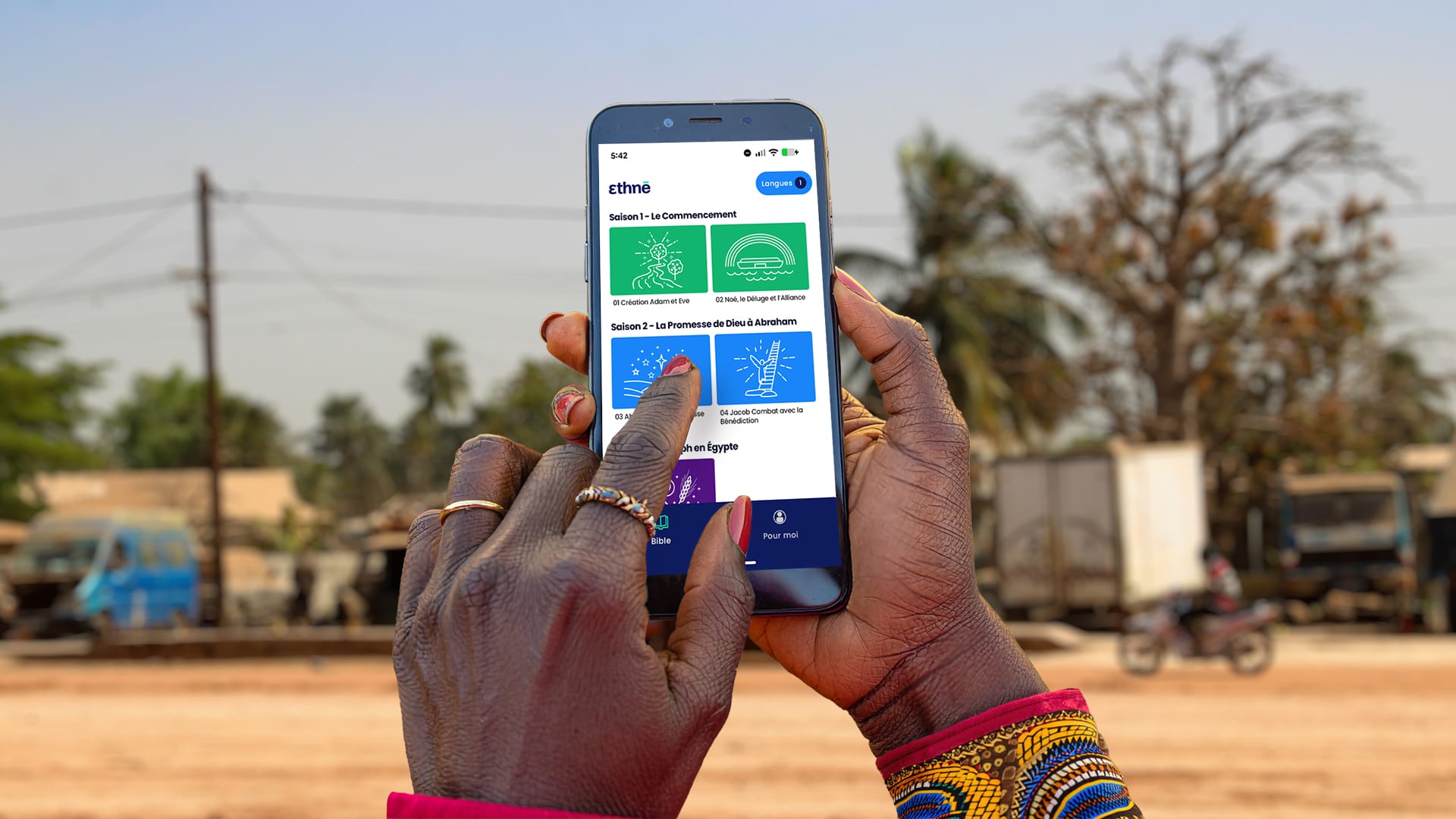
God speaks my language!
- Experience the Bible as one story from Genesis to Revelation
- Listen in your heart language. Read in another.
Download ethnē — the Bible app for all peoples.

