Indian Revised Version (IRV) - Urdu: Full Bible, Audio & Text Edition For Pakistan & India
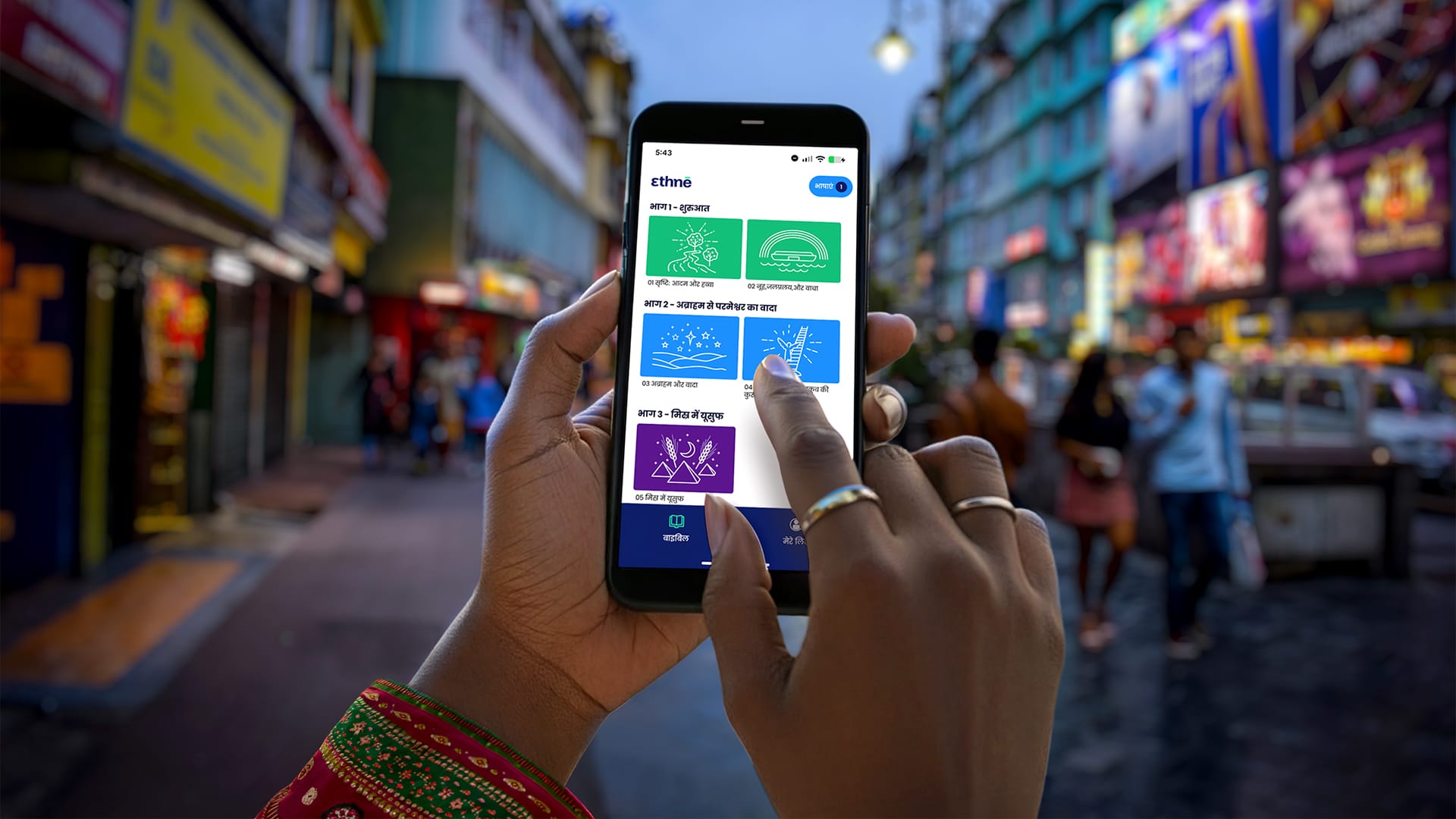
Urdu Full Bible Audio and Text translation from Davar Partners International and Bridge Connectivity Solutions added to ethnē!

Estimated Speakers: ~246 million speakers
Geographic Distribution: Spoken across Pakistan, India, and South Asian diaspora communities worldwide
Learn more: Ethnologue, Joshua Project and Wikipedia
Ethnologue's 2026 estimates rank Urdu as the 10th most widely spoken language in the world, with 246 million total speakers. Pakistan serves as the language's national home, where Urdu functions as the national and official language, while India recognizes it as an official Eighth Schedule language with status acknowledged in the Indian constitution. Beyond South Asia, significant Urdu-speaking communities populate the Middle East — particularly Saudi Arabia, the United Arab Emirates, Oman, and Qatar — as well as the United Kingdom, the United States, Canada, and Australia. Urdu belongs to the Indo-Aryan group within the Indo-European family of languages, sharing a close grammatical foundation with Hindi while drawing its literary and technical vocabulary heavily from Persian and Arabic. Urdu uses a modified form of the Perso-Arabic script known as Nastaliq (nastaʿlīq), while phonologically it retains a complete set of aspirated stops and retroflex consonants characteristic of Indo-Aryan languages.
A Bible translation in Urdu reaches speakers in the language they carry in their hearts — the language in which they think, pray, and process the deepest questions of life. For the millions of Urdu-speaking believers spread across Pakistan, northern India, and diaspora communities from London to Dubai, access to Scripture in Urdu removes a profound barrier. Relying on translations in English or another regional language creates distance from the text; Urdu Scripture allows believers to encounter God's word through the very idioms, rhythms, and literary structures their language has carried for centuries.
Show this QR code to a friend so that they can experience this Urdu Bible in ethnē today!

Urdu carries several regional varieties — including the prestigious literary standards of Lucknow and Delhi, and the distinct Dakhni (Deccan) dialect of South India. Because of Urdu's close relationship with Hindi, speakers of the two languages can generally understand one another when both sides avoid specialized literary vocabulary, since their syntax, morphology, and core vocabulary are essentially identical. This mutual intelligibility means that an Urdu translation carries reach well beyond the formally identified Urdu-speaking community, extending into the broader Hindi-Urdu speaking belt of northern India. The Nastaliq script, with its flowing diagonal baseline and elegant cursive letterforms, has long served as the primary writing system for formal and literary Urdu, though the IRV translation also serves readers through Devanagari script, meeting Indian communities where they are most literate. Culturally, Urdu commands deep prestige as a language of poetry, classical music, and Bollywood cinema — a heritage that gives Scripture in Urdu a natural gravitas and resonance with its audience.
The Christian community in Pakistan numbers approximately 3.3 million believers, representing 1.37% of the national population according to the 2023 census, with the majority belonging to the Church of Pakistan and the Roman Catholic Church. Services in these churches regularly incorporate Urdu alongside Punjabi and Sindhi to engage congregants from diverse ethnic backgrounds. The Church of Pakistan even appoints a dedicated bishop for Gulf Ministries to serve the pastoral and worship needs of Urdu-speaking workers in the Middle East. In India, Urdu-speaking Christian communities — particularly in northern states and urban centers — conduct worship, Bible study, and discipleship in Urdu, and the IRV translation gives pastors and teachers a contemporary, accessible text they can place directly in the hands of their congregations. For oral learners across both countries and diaspora settings, an audio version of the Urdu IRV translation makes Scripture available to those with limited literacy, enabling entire communities to hear God's word in their heart language.