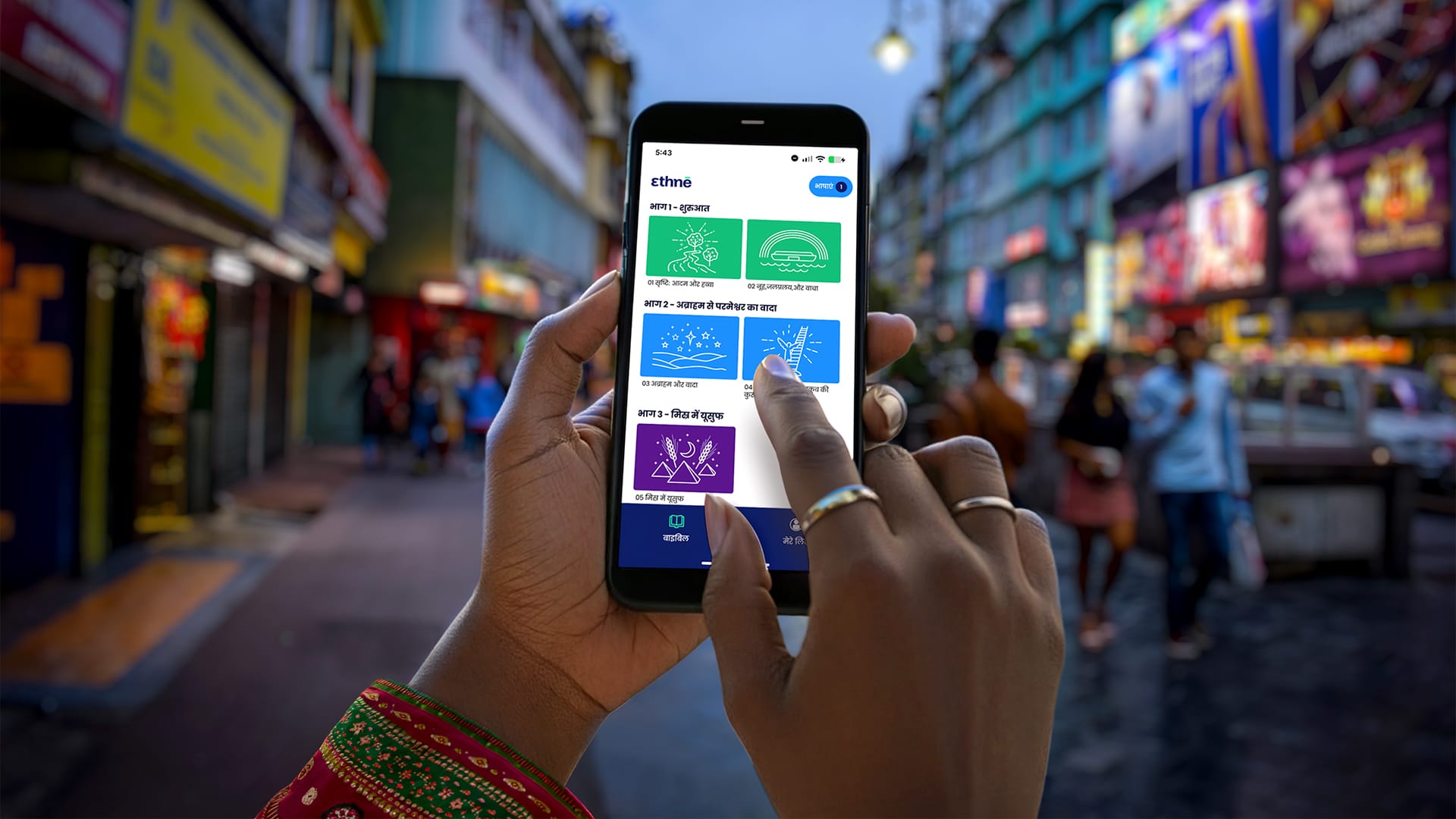
Indian Revised Version (IRV) - Hindi: Full Bible, Audio & Text Edition For India
Hindi Full Bible Audio and Text translation from Davar Partners International and Bridge Connectivity Solutions added to ethnē!
Estimated Speakers: 600 million speakers
Geographic Distribution: Spoken across Northern and Central India with diaspora communities worldwide
Learn more: Ethnologue, Joshua Project and Wikipedia
Hindi belongs to the Indo-Iranian branch of the Indo-European language family and serves as one of the two official national languages of India, where it functions as a lingua franca across large parts of northern and central India. With approximately 345 million native speakers and over 600 million total speakers, Hindi ranks as the third most spoken language in the world. At the state level, Hindi holds official status in Bihar, Chhattisgarh, Haryana, Himachal Pradesh, Jharkhand, Madhya Pradesh, Rajasthan, Uttar Pradesh, and Uttarakhand, as well as the Union Territory of Delhi, a region often called the Hindi Belt, which encompasses some of India's most densely populated territory. Beyond India, significant Hindi-speaking diaspora communities exist in Nepal, Fiji, Mauritius, South Africa, the United Arab Emirates, the United Kingdom, and the United States.
Hindi uses the Devanagari script, which is phonetic where each character represents a specific sound, making reading relatively straightforward once a learner masters the characters. The language also features a complex honorific system, with different verb forms and pronouns reflecting the social relationship between speakers. Linguists classify Modern Standard Hindi as a Sanskritized register of Hindustani, and its vocabulary draws deeply from Sanskrit for formal and literary registers while colloquial speech shows influence from Persian, Arabic, and more recently English. This rich layering makes Hindi a language of considerable literary depth and cultural prestige across South Asia.
Show this QR code to a friend so that they can experience this Hindi Bible in ethnē today!

The Indian census takes a broad view of "Hindi," encompassing a wide variety of regional dialects and spoken varieties across the Hindi Belt, which means that the population identifying as Hindi speakers includes communities whose everyday speech ranges from standard Khari Boli to regional varieties like Awadhi, Bhojpuri, and Rajasthani. The IRV (Indian Revised Version), completed in 2019, targets Modern Standard Hindi written in Devanagari — the prestige form that educated speakers across all these dialect regions recognize and read. This makes the IRV a practical bridge translation: communities whose mother tongue is a regional Hindi variety can still access Scripture through the standard form they encounter in schools, media, and public life. Despite the enormous size of the Hindi-speaking population, Hindi represents less than 0.5% of web content, which reflects a broader gap in digital resources for Hindi speakers and highlights the importance of making Scripture available through accessible apps and audio formats.
Reaching Hindi-speaking believers represents one of the largest evangelism and discipleship challenges in the world. Ministry organizations have established dozens of outreach centers across Hindi-speaking states, taking a holistic approach that connects churches with their communities through literacy programs, schools, and healthcare. For local congregations in this region, the Hindi IRV gives pastors and teachers a reliable, modern translation they can preach from and study in their heart language, removing the linguistic barrier that English-language Bibles create for many first-generation believers. Audio access through the ethnē app extends that same resource to oral learners and lower-literacy communities — making the full counsel of Scripture available to believers who have historically depended on secondhand summaries rather than the Word itself.